1900
500,000
individuals
A continent of rhino.
An estimated five hundred thousand black and white rhinoceros range across sub-Saharan Africa. The species are abundant, widespread, and largely undocumented.


Scroll forward through the long arc of the African rhino — from the abundance of 1900, through the collapse of the twentieth century, to the archive we are building for a generation we will not meet.
An estimated five hundred thousand black and white rhinoceros range across sub-Saharan Africa. The species are abundant, widespread, and largely undocumented.
Industrial-scale poaching, fueled by a global trade in horn, halves the African black rhino population in a decade. The southern white is rebuilding from a 19th-century near-miss.
The black rhino reaches its lowest recorded count: 2,475 animals. The genetic bottleneck this represents will shape conservation for the next century.
A small team of South African veterinarians and reproductive biologists establishes Rhino Repro as a non-profit dedicated to assisted reproduction in the white and black rhino.
The first successful ovum pick-up performed on a sedated rhino in South Africa. A single oocyte — small in number, foundational in protocol. Every subsequent retrieval builds on it.
Sudan, the last male northern white rhino, dies in Kenya at the age of 45. The subspecies now survives in two animals — both female, both in Ol Pejeta. Assisted reproduction is the only path back.
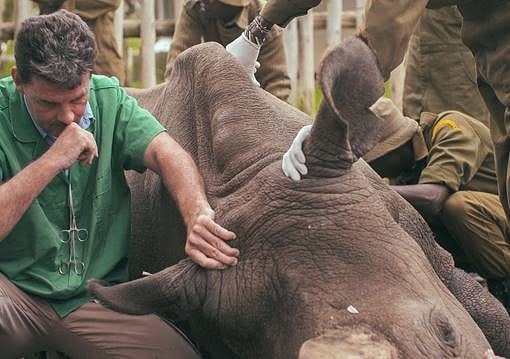
Twenty-three oocytes recovered in a single retrieval — the highest yield in our history. Validates the protocol at scale and meaningfully expands the genetic material entering the archive.

By the close of the year, Rhino Repro's biobank holds genetic material from dozens of individual animals across multiple partner reserves. Vitrification at −196°C is now routine.
A blastocyst cultured from biobanked material is transferred to a surrogate cow. If the pregnancy proceeds, it will be the first rhino in history born from a fully archived genome.
Our long-range goal: a permanent archive of every distinct living lineage across both species — sufficient breadth that no future bottleneck can render either rhino genetically unrecoverable.
If the work continues, a child born this year inherits a continent whose rhino are still here — living wild, supplemented by a permanent biological archive that outlasts any single lifetime.
· whether it has rhino on it depends on what we do this decade ·
Read by what is missing. An essay on extinction, the alphabet of loss, and the smaller word the same letters can spell.

Why an archive is the underwriter of every other conservation effort — and what minus one ninety-six degrees actually buys you.

A single egg, recovered in a single afternoon in 2017 — and the protocol that made everything since possible.

A note on origin — why a small group of South African veterinarians and reproductive biologists decided, in 2016, to build a biobank.